Can You Get a DUI in Pennsylvania for Driving After Taking Prescription Medication?
You took your medication exactly as your doctor ordered. Then you drove to work, picked up your kids, or ran an errand. A police officer pulled you over and asked about your pills. Now you face a prescription drug DUI charge. Many careful drivers never knew this charge was even possible. Pennsylvania law does not care whether a drug came from a dealer or a pharmacy. The question is whether the drug affected your driving. A valid prescription can help in some cases. It does not protect you in every case. Officers do not need a breath test number to make an arrest either.
This guide explains how the law works, which medications cause the most arrests, and how police build these cases. You will also learn the penalties and common defenses. If you already face a charge, a DUI lawyer can review the evidence before your first hearing.
Prescription Drug DUI in Pennsylvania: When Legal Meds Lead to Charges
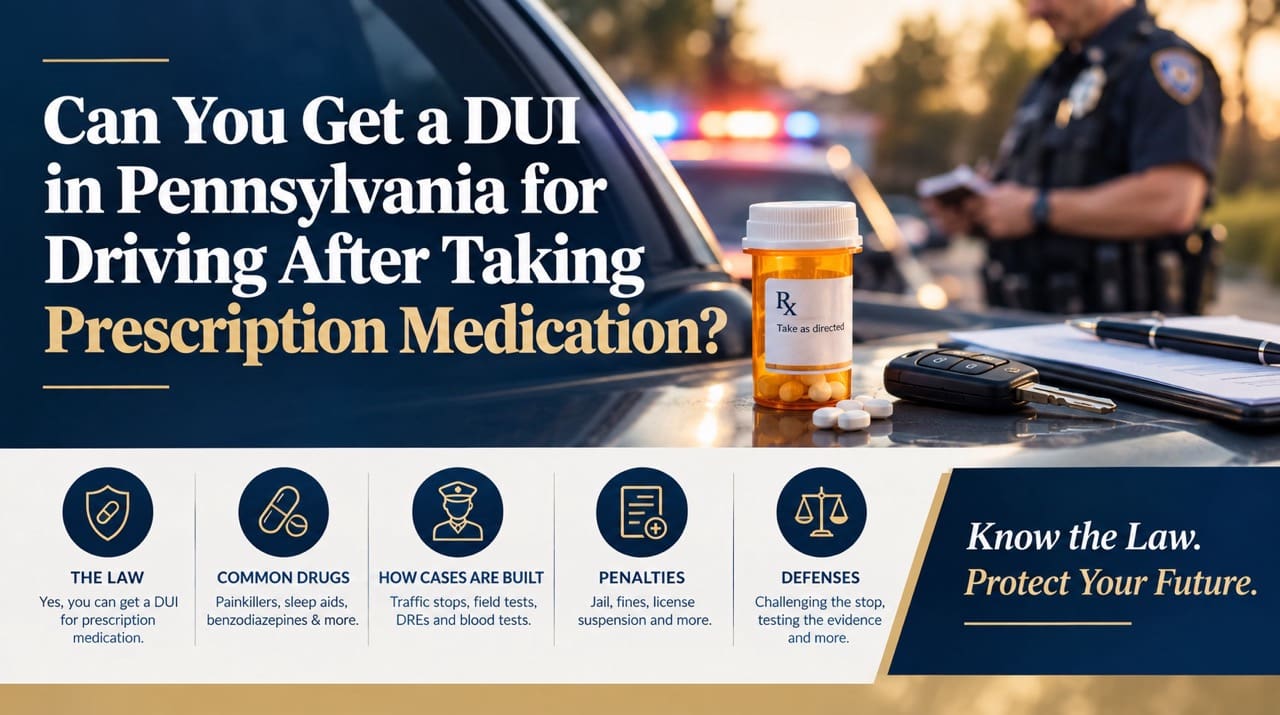
Yes, you can get a DUI for driving on prescription medication in Pennsylvania. The law sits in 75 Pa.C.S. § 3802(d). One part bans driving with any Schedule I drug in your blood. It also bans Schedule II or III drugs that a doctor did not prescribe for you. A valid prescription can defeat that charge. Another part, § 3802(d)(2), works differently. It bans driving under the influence of any drug that impairs your ability to drive safely. That section applies even to legal, prescribed medication. Most prescription drug DUI cases turn on this impairment rule. Our FAQ on what a controlled substance DUI is explains each subsection in detail.
Medications That Often Lead to DUI Arrests
Some medications carry a warning label for a reason. They slow reaction time, blur vision, or cause drowsiness. Others affect judgment in ways you may not notice behind the wheel. Officers see these drugs often during traffic stops. A new dose, a higher dose, or mixing medications raises the risk. Alcohol on top of a prescription can make impairment far worse. Pennsylvania treats that combination as its own DUI offense. Watch for these common drug types:
- Opioid painkillers: Oxycodone, hydrocodone, and codeine can cause drowsiness and slow reflexes.
- Benzodiazepines: Xanax, Klonopin, and Valium can impair coordination and alertness.
- Sleep aids: Ambien and similar drugs can linger into the next morning.
- Muscle relaxants: Drugs like Soma and Flexeril can cause dizziness and sedation.
- ADHD stimulants: Learn whether you can get a DUI for driving on Adderall and why it happens.
- Medical marijuana: A state medical card has not protected patients from DUI charges based on THC in their blood.
- Over-the-counter drugs: Some allergy and sleep medicines can cause impairment too.
How Police Build a Drug DUI Case
Drug impairment is harder to measure than alcohol. No roadside device gives a reliable drug number. So officers build these cases step by step, using several tools. Each step creates evidence that prosecutors later use in court. Each step also creates room for mistakes. Knowing how the process works helps you spot weak points. It also explains why your words at the roadside matter so much. Three stages shape most cases. Here is how each stage works.
The Traffic Stop and Roadside Tests
Most cases start with a traffic stop for weaving, speeding, or a minor violation. The officer then watches your speech, eyes, and movements. Questions about medication often follow. Many drivers freely list every pill they take. Those answers can become key evidence in a prescription drug DUI case. Officers may then ask you to perform field sobriety tests. These tests were designed to detect alcohol, not medication. Medical conditions, age, and nerves can also affect your performance. Learn whether field sobriety tests are mandatory before you face that choice. You can politely decline to answer questions about your medication.
The Drug Recognition Expert Evaluation
Some departments call in a Drug Recognition Expert, or DRE. This officer follows a 12-step evaluation to decide which drug category caused impairment. The steps include checking your pulse, blood pressure, pupils, and muscle tone. The officer then offers an opinion about the drug type. Prosecutors present that opinion at trial. Yet a DRE evaluation is not a lab test. It relies on the officer’s judgment and training. Illness, fatigue, or anxiety can mimic drug signs. So can common health conditions like diabetes or inner ear problems. A skilled lawyer can question whether the officer followed each step correctly.
The Blood Test
A blood test is the main chemical evidence in drug DUI cases. Pennsylvania’s implied consent law covers chemical testing after a lawful arrest. Police generally need a warrant to force a blood draw. Refusing a test can still trigger a 12-month license suspension for a first refusal. Blood results show that a drug was present at the time of the draw. For most prescription drugs, they do not prove impairment at a set level. Pennsylvania has no legal limit for most medications. That gap often helps the defense. Read what drugs are tested for in a Pennsylvania DUI blood test to learn more.
Does a Valid Prescription Protect You?
In a prescription drug DUI case, a valid prescription matters, but it is not a free pass. It can defeat a charge that rests only on a Schedule II or III drug in your blood. It cannot defeat an impairment charge under § 3802(d)(2). Prosecutors only need to show the drug impaired your ability to drive safely. Courts have said expert testimony is not required in every case. Officer observations, driving behavior, and test results can be enough. Taking more than your prescribed dose weakens your defense. Ignoring a label that warns against driving can hurt you too. Your medical records and pharmacy history can help or harm your case. A lawyer should review both first.
Penalties for a Drug DUI in Pennsylvania
Pennsylvania punishes drug DUIs in its highest penalty tier. That tier matches the penalties for a blood alcohol level of 0.16 percent or more. The consequences reach your job, your license, and your insurance rates. Judges also order safety classes and drug and alcohol evaluations. Treatment may follow if the evaluation recommends it. Some first-time offenders may qualify for diversion. Here are the penalties a prescription drug DUI can carry:
- First offense: 72 hours to 6 months in jail, a $1,000 to $5,000 fine, and a 12-month license suspension.
- Second offense: 90 days to 5 years in jail, a $1,500 to $10,000 fine, and an 18-month license suspension.
- Required programs: Alcohol Highway Safety School and a drug and alcohol evaluation, with treatment if recommended.
- ARD option: Some first-time offenders may enter the ARD program and avoid a conviction.
- Lasting effects: Higher insurance costs, a criminal record, and possible job or license problems.
How a Lawyer Can Fight the Charge
A prescription drug DUI often has more weak spots than an alcohol case. The science is less precise. The officer’s opinion carries more weight. Your medical history can explain signs that look like impairment. A careful defense starts with the reason for the stop and ends with the lab report. Every case is different, so your strategy should fit your facts. Early review keeps more options open. Common defense strategies include:
- Challenging the stop: Police need reasonable suspicion to pull you over.
- Questioning the DRE: Missed steps or poor training can weaken the officer’s opinion.
- Explaining symptoms: Medical conditions, fatigue, or injuries can mimic impairment.
- Contesting the blood test: Chain of custody, lab errors, and warrant issues can matter.
- Showing proper use: Records proving you took the correct dose can support your case.
Protect Your License and Your Record
A prescription drug DUI can threaten your license, your job, and your record. You took your medication to stay healthy, not to break the law. Attorney David McKenzie is a former prosecutor who now focuses heavily on DUI defense. He knows how officers build drug DUI cases and where they break down. McKenzie Law Firm, P.C. serves clients across Montgomery, Bucks, Chester, and Delaware Counties. More than 800 client reviews average five stars. Call (610) 756-1303 any time, day or night. You can also book a free consultation online. Talk to a lawyer before your first court date.
McKenzie Law Firm, P.C.
Phone Number: (610) 756-1303
Email Address: info@davidmckenzielawfirm.com
Office Hours: Mon-Fri: 8 AM – 5:30 PM, Sat-Sun: 9 AM – 12 PM
Blue Bell Office:
McKenzie Law Firm, P.C.
325 Sentry Pkwy, Building 5 West, Suite 200
Blue Bell, PA 19422
Exton Office:
600 Eagleview Blvd, Suite 300
Exton, PA 19341
King Of Prussia Office:
630 Freedom Business Center, 3rd Floor
King Of Prussia, PA, 19406
This article offers general information, not legal advice. Reading it does not create an attorney-client relationship. Past results do not predict future outcomes.