Delaware County DUI Lawyer

  1. Home
  2. »
  3. Criminal Defense Lawyer in Delaware County
  4. »
  5. Delaware County DUI Lawyer

A charge of driving under the influence (DUI) is a serious matter. Penalties can be severe, and failing to take the right legal steps during this stressful time can lead to serious legal, financial, and professional consequences. Everyone makes mistakes, but you deserve a vigorous defense and fair treatment under the law. If you are facing a DUI charge, contact a Delaware County DUI lawyer who may be able to reduce your sentence or even get your criminal case dismissed.

At McKenzie Law Firm, P.C., our Delaware County criminal defense lawyer knows the courts and how to fight for a resolution that will disrupt your life as little as possible. Call us today for a consultation.

What Are the Penalties for a DUI Conviction in Delaware County, PA?

Pennsylvania considers a blood alcohol content (BAC) of .08% and above to be legally drunk. However, drivers could potentially face charges even if their BAC does not meet that limit, under 75 Pa. C.S.A. § 3802.

If a police officer stops a motorist on suspicion of drunk driving and confirms they are intoxicated with a field sobriety test, the motorist will then have to submit to a chemical test of blood, breath, or urine. If the test shows the motorist is above the legal limit, the driver will probably face criminal charges for DUI.

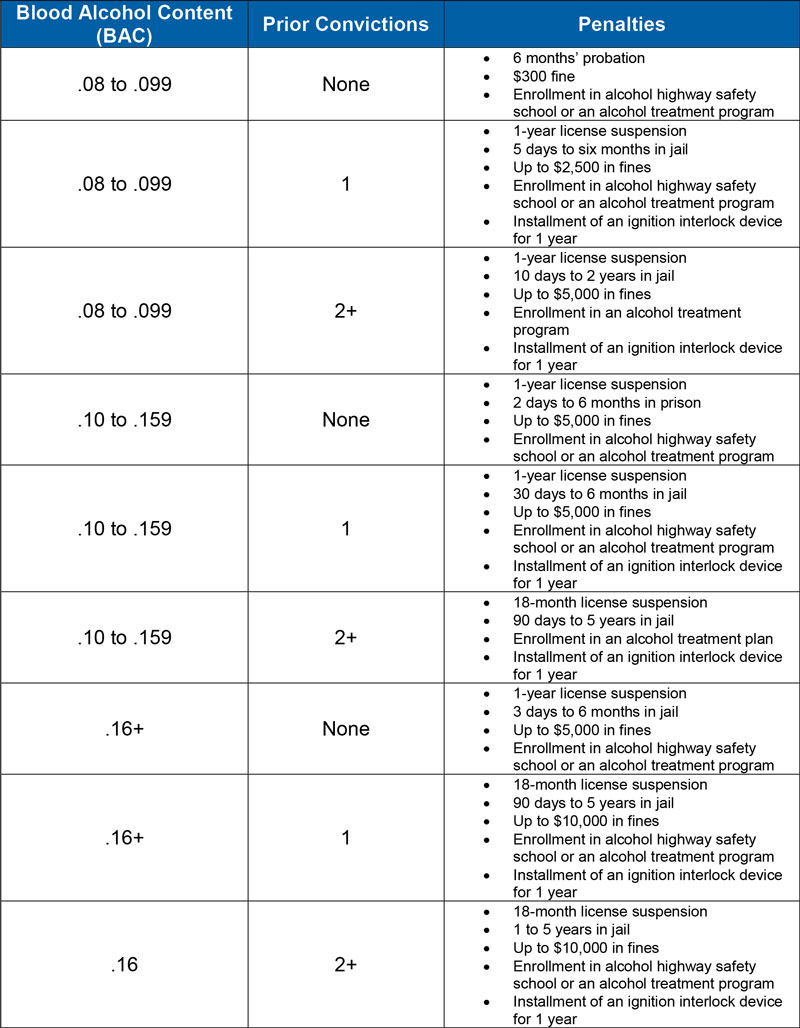
The state also has tough penalties for drunk driving under 75 Pa. C.S.A. § 3804. Possible fines, jail time, probation, and driver’s license suspension can all vary depending on factors such as:

  • How far above the BAC limit you were at the time of arrest
  • Whether you have previous DUI convictions on your record
  • Whether the impairment resulted in an accident that caused injury or death
  • Whether there was a minor in the car
  • Whether the driver was operating with a suspended license at the time of the DUI arrest

Because penalties depend on the specific facts of your case, it’s important to seek legal advice about which factors may apply to your situation.

Pennsylvania DUI Penalties

What Will a Delaware County DUI Lawyer Do for Me?

We will begin by examining the details of your arrest and asking some of the following questions of law enforcement, such as:

  • Was the officer justified in stopping you on suspicion of drunk driving?
  • Was the field sobriety test administered properly?
  • Are the BAC test results admissible as evidence?
  • Was the suspension of your license carried out properly?

Officers in Delaware County must be able to demonstrate they had reason to believe you were operating a vehicle while intoxicated before pulling you over. While you are not required to comply with a field sobriety test, Pennsylvania law establishes “implied consent.” This law requires motorists arrested for a DUI to submit to a chemical BAC test. Refusal will result in an automatic license suspension.

Our Delaware County DUI lawyer can investigate whether the officer completed this testing properly and whether the equipment involved, such as a breathalyzer test device, was functional and properly calibrated. If not, this evidence could be inadmissible in court.

At McKenzie Law Firm, P.C., we do everything we can to minimize the negative impact of the DUI. Services include helping you with the complicated process of petitioning the state for a partial restoration of driving privileges through an Occupational Limited License (OLL). This license, also known as a “bread and butter” license, allows you to drive to work and other necessary appointments.

Common Mistakes People Make After a DUI Arrest

Many people unintentionally make their situation worse by taking actions that harm their defense. Here are some things you should avoid doing:

  • Talking to police or prosecutors without legal representation: You have no obligation to explain yourself, and doing so may give the prosecution more evidence to use against you.
  • Missing court dates or PennDOT deadlines: Even a single missed deadline can lead to additional charges or automatic license consequences.
  • Posting on social media about the arrest: Photos, comments, or jokes about the incident can be taken out of context and used by the prosecution.
  • Failing to request an Occupational Limited License (OLL) quickly: If you qualify, this license can help you maintain your ability to get to work, school, or medical appointments.

Our DUI lawyer serving Delaware County can help you avoid these missteps and keep the case on track.

How DUI Cases Move Through the Delaware County Court System

Many people facing DUI charges have never interacted with the criminal courts before. Knowing how cases progress through the Delaware County system makes the process easier to manage.

Arrest, Booking, and Preliminary Arraignment

After a roadside stop and arrest, police will typically transport you to a Delaware County processing facility or local police department. There, you may undergo chemical testing, fingerprinting, and initial paperwork before being released. If you are held rather than released, you would typically be taken to the George W. Hill Correctional Facility in Thornton, which houses both pretrial detainees and sentenced individuals for Delaware County. Many first-time DUI offenders are released with a summons rather than held in custody, but this varies depending on the circumstances of the arrest.

Shortly after your arrest, you’ll typically have a preliminary arraignment, where you learn the official charges against you and receive notices about your upcoming court dates. Your preliminary arraignment typically takes place within 24 hours of your arrest, or on the next business day if you were arrested outside of court hours. It is crucial not to ignore any paperwork you receive during this stage, since even missing one deadline can lead to additional penalties, including a bench warrant for your arrest.

The Preliminary Hearing

The preliminary hearing is one of the most important early stages of a DUI case, and it takes place at the Magisterial District Court covering the area where you were charged. Under Pennsylvania court rules, this hearing is generally scheduled within 14 days of your preliminary arraignment if you’re in custody, or within 21 days if you’re not. During this hearing, the prosecution must show there is enough evidence to move the case forward.

Your attorney can question witnesses, challenge weak evidence, and negotiate with prosecutors. In some situations, the charges may be reduced or eliminated based on the outcome of this hearing.

Formal Arraignment

If your case continues, the next step is a formal arraignment in the Delaware County Court of Common Pleas in Media, PA. This step typically follows several weeks after the preliminary hearing, though the exact timing can vary based on the court’s schedule. You will enter a plea and receive more detailed information about the charges and possible penalties. This is also when the court sets deadlines for motions, discovery, and other procedural steps.

Pretrial Conferences and Negotiations

Before any case goes to trial, the court generally schedules one or more pretrial conferences. These meetings give your attorney opportunities to negotiate with the prosecution, request access to evidence, and explore alternatives, such as placement in the Accelerated Rehabilitative Disposition (ARD) program for first offenders.

In Delaware County, admission into ARD is reviewed by the District Attorney’s Office on a case-by-case basis, and applying requires waiving your right to a formal arraignment before your scheduled date. Many DUI cases are resolved during this stage without ever reaching trial.

Trial, if Necessary

While DUI trials are not as common as negotiated resolutions, some cases do proceed to trial, where your lawyer can challenge the prosecution’s evidence, cross-examine arresting officers, and present a defense on your behalf. McKenzie Law Firm, P.C., represents clients throughout the entire court process and works to reduce disruptions to your work, family, and daily life.

Common DUI Defenses Used in Delaware County Cases

Every DUI case is unique, and the right defense strategy depends on the specific circumstances of your arrest. McKenzie Law Firm, P.C., analyzes every detail to identify weaknesses in the prosecution’s case. Some defenses that may apply to your situation include:

Challenging the Legality of the Traffic Stop

Police must have reasonable suspicion to stop your vehicle. If the officer lacked a legitimate reason for the stop, any evidence gathered afterward, including BAC test results, may be suppressed.

Questioning the Officer’s Observations

Officers often rely on subjective observations, such as slurred speech, red eyes, or unsteady movement. Medical conditions, fatigue, or nerves can mimic signs of impairment. These factors can be challenged, weakening the prosecution’s case.

Improper Field Sobriety Testing

Field sobriety tests must follow specific protocols. Poor lighting, uneven pavement, medical limitations, or officer error can invalidate the results.

Rising Blood Alcohol Content

A driver’s BAC can rise between the time they last consumed alcohol and the time they are tested. This means you may have been below the legal limit while driving but above it during testing. Raising this defense requires a careful examination of timelines and scientific evidence.

Chain of Custody Issues

If your blood sample was mishandled, mislabeled, or improperly stored, the results may be unreliable. Equipment errors and procedural mistakes can significantly influence the outcome of a case.

These defenses show why having a knowledgeable DUI lawyer matters. The prosecution’s case is not always as strong as it appears, and our attorney can often find opportunities to reduce, dismiss, or resolve charges in your favor.

Legal Options for First-Time Offenders

Pennsylvania offers the Accelerated Rehabilitative Disposition (ARD) program to first-time, nonviolent offenders. This pretrial intervention allows offenders who have no previous records and appear as if they are likely candidates for successful rehabilitation to circumvent the costly and slow legal process. Successful completion of the ARD program can result in your DUI charge being dismissed.

You May Be Able to Get Your DUI Charge Dismissed

If you meet all the terms of the ARD program, your DUI charges are dismissed. You will not face harsh penalties such as jail time or having a permanent conviction on your record. Furthermore, you will gain the right to ask the court to expunge your record. This will ensure that your DUI arrest is not visible on background checks.

You May Be Able to Get a Plea Deal

You may also have the option of pleading the case down to a “wet reckless,” or alcohol-related reckless driving. This option is for drivers whose BAC levels were close to the .08% limit, who did not cause damage or injury, and who otherwise have clean records.

Penalties for a wet reckless are less harsh, and the offense will not appear on your driving record as a DUI.

Can I Get a DUI Expunged From My Record?

In addition to providing legal counsel through the stressful and confusing process of DUI investigation, plea bargaining, and sentencing, our criminal defense attorney works to improve our clients’ long-term well-being. We do not believe a single mistake should derail a person’s entire life.

A DUI is the sort of offense that can follow you around even after you satisfy the terms of your sentence. Here are some ways having a DUI on your criminal record can impact your life for years to come:

  • It might be harder to get a job
  • Your insurance rates will increase
  • You might not be able to rent a car

For those reasons, it is in your interest to have the DUI expunged or fully erased from all official records. Expunging a DUI is complex, but we can handle it for you in the final stages of your DUI case.

ARD participants are automatically eligible to have their DUIs expunged. It requires some paperwork, which our legal team can handle for you. The process is much more difficult if you are not in the program.

Delaware County DUI Checkpoints: What Drivers Should Know

Checkpoints are legal in Pennsylvania, but police must follow strict rules to protect motorists’ rights.

How Checkpoints Operate

Before conducting a checkpoint, law enforcement agencies must establish guidelines that determine:

  • The specific location
  • The time and duration
  • Neutral, predetermined criteria for stopping vehicles

Officers cannot stop drivers randomly. They must follow the pattern set in advance, such as every third or fifth vehicle.

Your Rights at a Checkpoint

Drivers often feel anxious during checkpoint stops, even when they have done nothing wrong. At a DUI checkpoint, you have the right to:

  • Remain silent (other than providing license, registration, and insurance)
  • Decline field sobriety testing
  • Avoid answering questions about alcohol consumption

However, refusing a chemical test after an arrest can trigger an automatic license suspension due to Pennsylvania’s implied consent law.

How We Defend You Against Checkpoint Arrests

If you were arrested at a checkpoint, our lawyer may examine whether officers followed protocol. Any deviation from the approved plan could render the stop unconstitutional, which may lead to evidence being excluded.

Understanding BAC Testing and Common Issues With Chemical Tests

Chemical testing is a critical part of any DUI case, but these results are not always accurate. Pennsylvania uses three types of BAC testing: breath, blood, and urine, and each has its own vulnerabilities.

Breath Testing Concerns

Breath test results can be influenced by factors such as:

  • Improper machine calibration
  • Residual mouth alcohol
  • Acid reflux or GERD
  • Officer training errors

If the instrument was not inspected according to state regulations, the results may be challenged.

Blood Testing Issues

Blood tests are often considered more reliable, but they are not infallible. Potential problems include:

  • Delays between driving and testing
  • Fermentation in improperly stored samples
  • Errors at the lab
  • Breaks in the chain of custody

When these issues occur, the accuracy of the test comes into question.

Urine Testing Limitations

Urine tests are rarely used because they are less accurate in determining blood alcohol levels. When they are used, our lawyer may scrutinize whether proper procedures were followed.

A thorough review of BAC testing procedures can uncover errors that weaken the prosecution’s case.

Penalties for Refusing a Chemical Test in Delaware County

Pennsylvania’s implied consent law requires drivers who are lawfully arrested for DUI to submit to chemical testing. Refusing a test does not prevent the state from prosecuting you for DUI, and it may actually result in harsher penalties.

Administrative License Suspensions

Test refusal triggers a civil license suspension separate from any criminal penalties. This penalty means you may lose your driving privileges even if your DUI charges are later reduced or dismissed.

Impact on ARD Eligibility

Refusing a chemical test can make it harder to qualify for the ARD program. For many first-time offenders, ARD is the best opportunity to avoid jail time and ultimately expunge the DUI record. Our DUI defense lawyer can review whether the facts support a refusal violation.

Challenging a Refusal Allegation

Sometimes, an alleged “refusal” stems from misunderstanding or officer error. Our legal team can challenge the allegation and work to protect your driving privileges.

Speak With a Delaware County DUI Attorney About Your Case

With all of the stress and complexity that a DUI will add to your life, it is important to have a legal team on your side. Our Delaware County DUI attorney wants to get you back to your regular life. Once you become a client, we are available to answer any questions you have via phone, email, and text.

Call McKenzie Law Firm, P.C., today for a consultation.

Delaware County Practice Areas
  • Ard Application
  • Ard Program Lawyer
  • Battery Defense
  • Child and Youth Services
  • Child Pornography
  • Drug Crimes
  • DUI
  • Gun
  • Gun Crime
  • Traffic Crimes
  • Under 21 DUI
  • White Collar Crimes
  • Unfit Parent Defense
Find a Competent DUI Lawyer Now!
  • Lower Makefield DUI Lawyer
  • Marple DUI Lawyer
  • Abington DUI Lawyer
  • King of Prussia DUI Lawyer
  • Philadelphia DUI Lawyer
  • Upper Dublin DUI Lawyer
  • Bensalem DUI Lawyer
  • Springfield DUI Lawyer
Our Awards & Associations
Free Case Evaluation